
Blog

  • 5 Biological Fundamentals That Shape Your Internal Environment

    5 Biological Fundamentals That Shape Your Internal Environment

    Inspired by this Instagram reel. All credit to the original creator.


    I came across this instagram reel and thought that it was a great summary of information i’ve recently come across with relation to the environment you create within your body to either hinder or promote the growth of cancer cells.

    Cancer doesn’t grow in isolation. It grows within a biological environment shaped by the conditions we create, often over years. Researchers call this the “terrain,” and the science behind it sits at the intersection of oncology, immunology, and metabolic medicine. The premise is not that lifestyle replaces treatment — it’s that the internal environment influences how cancer behaves, and that environment is not fixed.

    That framing raises a practical question: what actually shapes the terrain?


    1. Inflammation

    Chronic low-grade inflammation is one of the most consistently studied drivers of cancer progression. It’s not the acute kind you feel after an injury — it’s the kind that runs quietly in the background for years, driven by diet, stress, environmental exposures, and metabolic dysfunction. Most people have no idea it’s there.

    Identifying and reducing the sources of chronic inflammation is one of the highest-leverage things you can work on. It’s also one of the most responsive to change.

    2. Blood Sugar and Insulin

    Insulin is a growth-promoting hormone. When it’s chronically elevated — through high-glycaemic eating, poor sleep, or inactivity — it sends a persistent growth signal throughout the body. That signal doesn’t discriminate.

    Stabilising blood sugar isn’t a vague wellness recommendation. It has a direct mechanistic relationship with cancer biology, and it’s something diet, movement, and sleep all meaningfully influence.

    3. Sleep and Stress Hormones

    The immune system does a significant portion of its maintenance work during sleep — including identifying and clearing aberrant cells. Cortisol dysregulation and chronic poor sleep impair that process, disrupt cellular repair, and push the body into a prolonged state of physiological stress.

    Protecting sleep quality is one of the most underrated interventions available. It touches nearly every other system on this list.

    4. Gut Health and Immune Function

    A substantial portion of immune activity originates in the gut. The gut microbiome has bidirectional relationships with inflammation, metabolism, and even how well treatment works — this is an active and growing area of cancer research.

    A depleted or dysregulated gut creates a more hospitable environment for disease and a less capable immune response. Supporting it isn’t alternative medicine — it’s foundational biology.

    5. Nutrient Status and Detox Capacity

    Cells need raw materials to function correctly. Deficiencies in key micronutrients — vitamin D, magnesium, zinc, B vitamins among them — are common in people with cancer, often compounded by treatment side effects. Meanwhile, the liver and lymphatic system are under increased load and need support, not neglect.

    Detox capacity and nutrient status don’t get enough attention relative to how much they matter day-to-day.


    Why This Matters

    None of these fundamentals is a cure, and I want to be clear about that. But they’re not irrelevant either — and that’s often how they get treated.

    The internal environment responds to what you eat, how you sleep, how you manage stress, and how you move. Those responses are measurable and they have clinical significance. The growing field of integrative oncology is building an evidence base around exactly this — not replacing conventional treatment, but optimising the terrain within which everything else operates.

    You may not control every outcome. But the ecosystem isn’t beyond your influence, and that matters more than people often realise.

    -Matt & Kerstin


    This post is inspired by a personal account shared via Instagram. All credit belongs to the original creator. This content is for informational purposes only and does not constitute medical advice. Always work with your healthcare team when making decisions about cancer treatment and supportive care.
  • Food as Medicine or Poison: How We Think About What We Put In Our Bodies

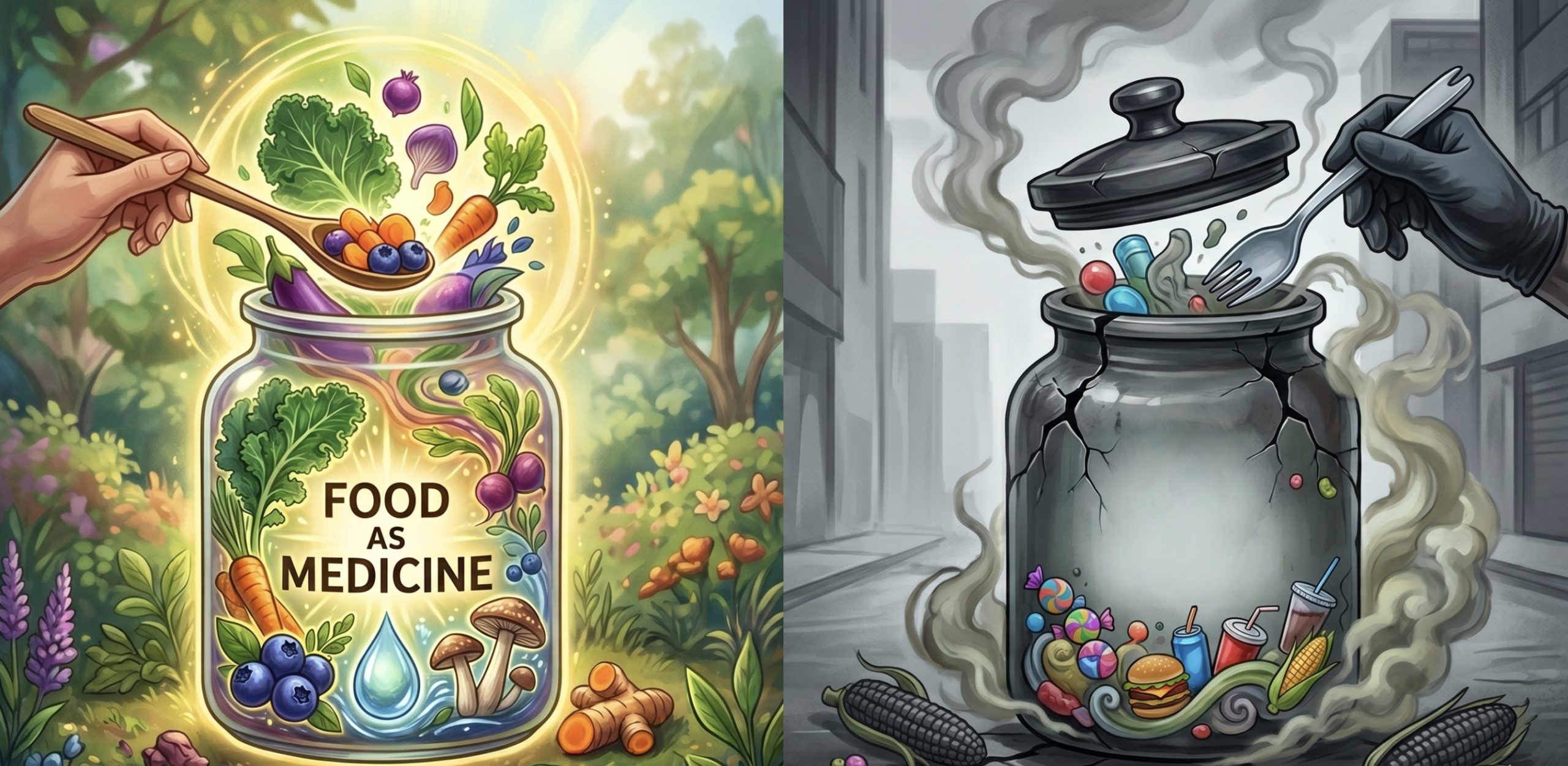
    Food as Medicine or Poison: How We Think About What We Put In Our Bodies


    Introduction

    Most of us were raised with a fairly simple idea of what it means to eat well: eat your vegetables, limit junk food, drink water. And while that’s not wrong, it’s incomplete and in a world flooded with health content, incomplete information can be just as misleading as bad information.

    This is the first post on Nourishing Pod, and before we get into specific topics, we want to explain how we approach everything we publish here. Because the framework matters.

    The Core Idea: Nourishment vs. Toxicity

    We look at everything we consume food, drink, household products, personal care items through two lenses:

    Does this nourish the body? Does it provide what the body needs to function, repair, and thrive?

    Or does this introduce something the body has to work to neutralise, eliminate, or tolerate?

    The answer is rarely black and white. Most things sit somewhere on a spectrum, and context changes everything. That’s the point we want to make from the start.

    Why Context Is Everything: The Fruit Example

    Take fruit. Fruit is good for you. This is broadly true and well supported by evidence. Fruit contains vitamins, minerals, antioxidants, and fibre. Populations that eat more whole fruit have better health outcomes across multiple studies.

    But strip away the context, and the story changes quickly.

    Fruit contains fructose, a form of sugar. When you eat a whole piece of fruit, the fibre slows the absorption of that sugar into your bloodstream, blunting the glucose spike and allowing your body to process it gradually. The fibre also feeds beneficial gut bacteria and contributes to satiety. You feel full.

    Now juice that same fruit. The fibre is gone. What you’re left with is essentially a concentrated sugar drink that absorbs rapidly, spikes blood glucose, and delivers none of the satiety of the whole food. A glass of orange juice can contain the juice of four or five oranges, an amount most people would never sit down and eat in one go.

    So is fruit good for you? Yes. Is fruit juice the same as eating fruit? No, not really. Should you avoid fruit altogether because of the sugar content? Also no, eaten whole and in reasonable quantities, the benefits outweigh the concerns for most people.

    This is one small example. But the pattern repeats constantly across nutrition science, and it illustrates the problem with how health information gets communicated.

    The Problem with Simplification

    Health content on social media, in news headlines, and even in some popular books tends to collapse complex topics into simple rules. Eat this. Avoid that. This food causes cancer. This superfood reverses ageing.

    The simplification happens for understandable reasons. Nuance doesn’t travel well in a headline. But the result is that people end up with a patchwork of rules that often contradict each other, and no underlying framework to make sense of them.

    Someone who has heard “fruit has too much sugar” might avoid it and reach for something processed instead. Someone who has heard “juice counts as a serving of fruit” might drink it freely without understanding the difference. Both are acting on information that is technically derived from real science but stripped of the context that makes it useful.

    This is what we mean when we talk about incomplete information being as problematic as bad information.

    How We Approach Topics on This Site

    We are not scientists, and we are not giving medical advice. What we are doing is taking the time to understand the evidence properly including the caveats, the study limitations, the population sizes, and the practical implications and presenting it in a way that is honest about complexity.

    When the evidence is strong, we’ll say so. When it’s mixed or preliminary, we’ll say that too. When something that sounds alarming is actually well within the body’s normal capacity to handle, we’ll give that context rather than encourage unnecessary fear.

    We’ll also be specific about what we’re talking about. “Sugar is bad” is not a useful statement. “Rapidly absorbed fructose in large quantities, particularly from liquid sources, is associated with metabolic dysfunction” is a more accurate one and while it’s less catchy, it’s the kind of specificity that helps you make better decisions.

    What’s Coming

    In the posts ahead, we’ll be covering food and nutrition, reducing toxins in everyday products, understanding food labelling, the gut microbiome, children’s health, and more. Each topic will be approached the same way: start with the evidence, acknowledge the complexity, and give you something practically useful at the end.

    We think you can handle the nuance. That’s why you’re here.

    — Matt & Kerstin